

By 2022, the internet was already overrun with “slop”: bot accounts, engagement farmers, and SEO-optimized articles. But with the release of ChatGPT, the amount of slop on the internet, as well as in the creative sphere, has exploded. I especially notice this on text-based platforms like Twitter, LinkedIn, Substack, as well as Youtube comments.
I think that most people, even pro-AI people, think that AI slop stampeding over social media is an inevitable side effect of AI. This is simply not true. Nothing about this is inevitable, AI detectors are already really good, and they should be used to keep content on these spaces human-made.
In this essay, I will argue that Substack, and to the extent possible, all online platforms should ban AI generated content using AI detection tools like Pangram.
AI images and videos are outside of the scope of this essay, but I believe they should probably also be banned from social media.
Before we get started I want to clarify that I am not a Luddite, I am not anti-AI. I am a software engineer and I talk to Claude all day. I used ChatGPT to do some of the research for this essay. I think that AI is likely the most revolutionary technology ever and will propel us into an amazing future.
But, I am also a reader who has been radicalized by the number of AI-generated articles here on Substack.
AI generated content is accelerating, and people are reading it all of the time without even knowing it.
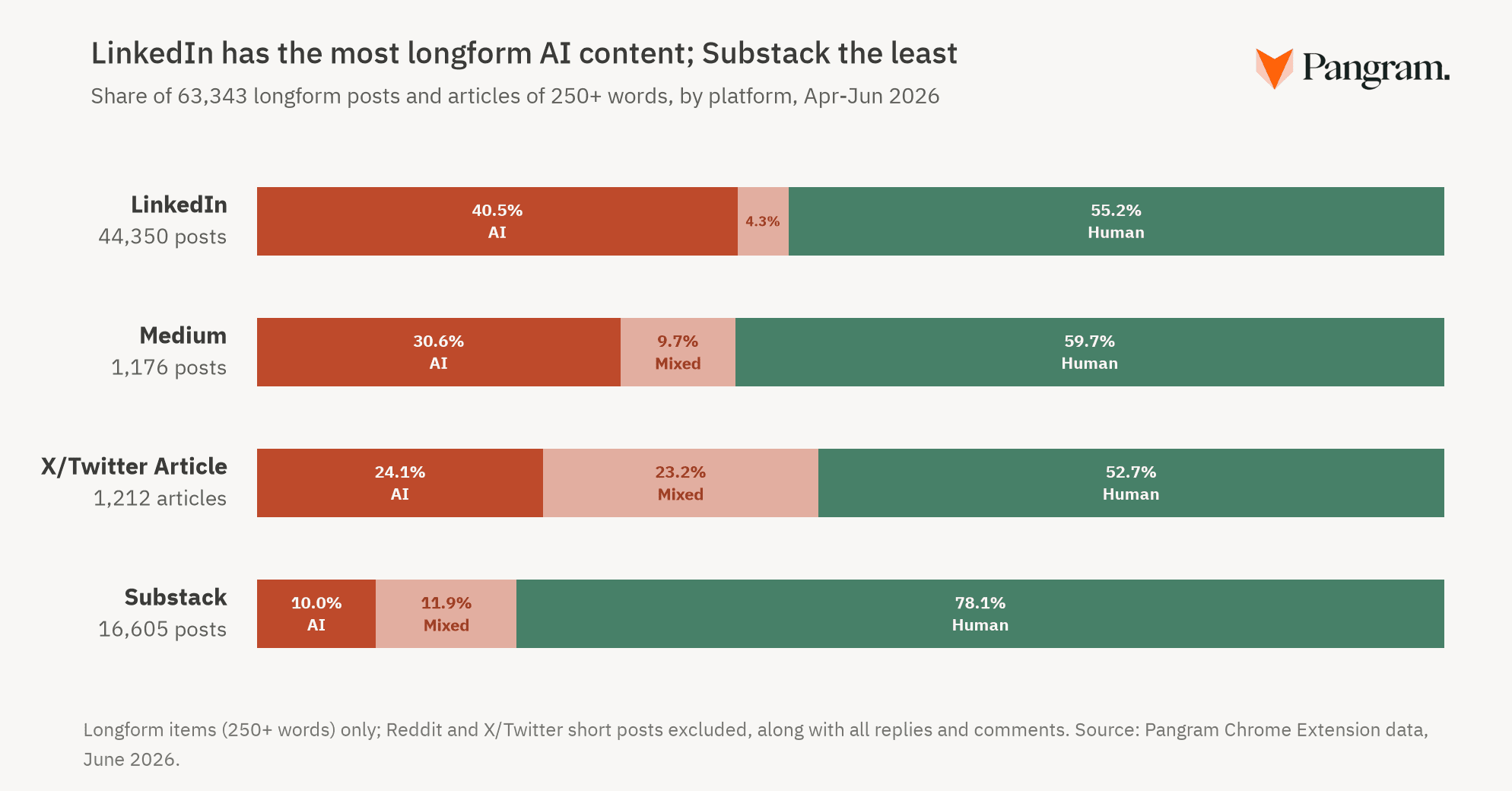
This honestly does not need much proving. Research estimates that more than 35% of webpages written since 2022 are AI generated. Some estimate this to be as high as 50% (meaning that there is more text being generated by AI than by humans). On social media, Pangram found that up to 30% of long-form Twitter posts and 40% of LinkedIn posts were written with AI. This honestly strikes me as low, and I wouldn’t be surprised if some of it has to do with the fact that AI detectors are not very good at evaluating shorter texts (like replies). Notably, Substack has some of the lowest rates of AI-generated content, but still around 20%, or 1 in 5 articles, are AI written or AI-assisted.
Broadly though, the platforms themselves are aware. Substack added a built-in AI-detector in partnership with Pangram in July 2026. Around the same time, LinkedIn added a “report AI slop button” (though, if I recall, LinkedIn premium actually comes with a feature that rewrites your posts and DMs with AI, so I’m not really sure of their stance). Instagram has been using C2PA metadata to classify images as AI since 2024. Twitter allows users to self-label content as AI generated.
AI generated content runs exactly counter to the purpose of social media
There is much to be said about “social media” and its purpose in modern life. It is clear to me that social media has long strayed from its original purpose. No longer is the goal to connect the world or to catch up with friends, and in this way the Instagram, Substack and Twitter of today are unrecognizable as social media. Now, they are now apps and websites that you visit primarily to consume and share content.
While there is certainly debate about the value of social media pre-2022, given the issues of misinformation, polarization, shortening attention spans, loneliness (just to name a few). It is undeniable that it was social media. The content was created entirely by and for other human beings.
But AI has propelled us into a new age of “social media”. You can find thousands of LinkedIn posts that are completely AI-rewritten. You will see Twitter replies that are just bots rephrasing the original tweet, and threads with bots arguing with bots. In this way AI-generated content serves to close the loop by flooding social media with what we could call “non-social media”.
Nowhere are AI effects more pernicious than on Substack. The entire point of Substack is the exchange of fleshed out articles and ideas written by people. But today, AI generated articles get thousands of likes. You may enjoy these AI-generated or AI-assisted articles. You may even have written some, but I implore you to dig deep and ask yourself, what is the point of being on social media?
Why open Substack, when you could just open ChatGPT instead?
The argument here is this: Even before AI, social media became more about content than about human-to-human connection. We may be against this, but at least the content was created by a human. Of course you might say that there is a human prompting the AI, or creating the bots, but to me it seems like even this level of AI use is fundamentally incompatible with social media. We are here to interact with and see ideas from other people, and AI content is at best a proxy for another person and at worst completely person-less.
AI generated content is offensive and flattens humanity’s diversity.
A couple things are clear to me:
Writing a post or an article with AI takes substantially less effort than writing it yourself
AI may have good ideas or prose, but they are not your ideas or prose
Presenting AI-generated ideas or prose as your own is suspicious at best
At present, I certainly find AI generated writing offensive because it is not very good, but I will acknowledge that some people find it good and that it is only getting better. However, I think that it is offensive in another way: reading takes time. I want my time to be well spent, and if I spend my time reading something that you did not even spend the time to write, then that offends me. You are wasting my time.
Furthermore, it is especially offensive when writing purports to be the author’s opinion (even going as far to use first-person), but I then find that it is AI generated. This is, at the very least lying to readers, and at worst something resembling plagiarism. And, to connect back to the previous section, what is the point of me reading your writing, if you did not even write it?
But this has a deeper effect as well, it is not as if every person suddenly had a very smart ghostwriter behind their tweets and articles. It is as if we all had the same ghostwriter. A study conducted in 2024 found that AI-assisted short stories tended to be better, and may have increased the creativity of each individual story, but the diversity among the stories was lower. They found that AI decreased the creativity of the aggregate.
In some contexts it may not be as important to write yourself, it may actually be for the best that AI is involved and can correct your human errors and rewrite your messy prose. However, especially on platforms like Substack, in my opinion it is essential that the human-ness of human writing is maintained. Individuals need to develop their own voice and their own opinions. People need to be wrong and people need to post weird and original things.
I do not think that AI necessarily has motives to steer us or we are experiencing some kind of mass superpersuasion, nor do I think that talking to AI to research a subject is that dangerous. In fact I even think that AI is pretty good at fact-checking and researching. But, I do think that AI has biases, and that flattening out the diversity of human writing is detrimental to our discourse and is anti-creative.
AI generated social media posts are genuinely off-mission and potentially hurt achieving AGI/ASI
I sympathize with the anti-AI artist types when they say of AI: “who asked for this?”.
To give an analogy, the internet is obviously an amazing technology, it has connected the world and brought people closer together. You can stream movies and order packages online. You can talk with your friends and family no matter where they are in the world. In some sense, we did ask for this.
But, did we ask for infinite algorithmic feeds that only exist to show us ads? Did we ask for higher rates of loneliness and childhood depression? Did we ask for platforms that benefit from dividing and polarizing our society? Does our revealed preference for these things mean that we are doomed to scroll Instagram Reels forever? It’s not so clear.
When it comes to AI we are facing an even more obvious trade off. I want software development to be automated. I want cures for diseases and magical new technologies. I want to be able to work less or even not work at all. I want Machines of Loving Grace.
So what do AI generated Twitter replies and LinkedIn posts have to do with this? What do slop Substack articles have to do with AGI or ASI? Clearly, nothing.
This is, on its face, off-mission. AI as it stands is useful in search, chatbots, personal assistants, coding, and even solving open problems in math. Advancing AI capabilities so that it can be even more useful in even more fields seems like, if we can avoid catastrophe, amazingly good. But nowhere in this mission is “automating slop posting”.
Furthermore I think that this is important because this is how a lot of people interact with AI. Most people are not software engineers or solving open math problems, their main interaction with AI is just seeing AI slop everywhere. This is nowhere near the only reason that the general public is against AI, but it definitely is one. It makes me worried that AI slop online doesn’t just not help the mission, but may actively be hurting public adoption and acceptance of AI.
It is possible, and potentially even cheap to detect and ban AI generated content.
AI-detection tools like Pangram, GPTZero, and potentially even the models themselves are extremely accurate at identifying AI-generated text. The leader, Pangram, advertises a 99.66% accuracy rate. On top of that, the model providers (Google, Anthropic) are implementing things like text watermarking, which makes AI text intentionally easy to spot.
Pangram and other platforms are already relatively cheap, but of course will be expensive at scale. However, we could imagine that AI-generated content moderation will get much cheaper over time. Companies could build their own in-house solutions, or use open-weight AI detection models to not having to rely on third parties while reducing cost.
So, Ban AI Generated Content
Concretely, here is what a ban on AI generated content could look like on Substack:
Every article, post, and article edit is scanned by Pangram before it can be posted.
If a post is found to contain more than some reasonable threshold (say, 10%, since there may be legitimate reasons to include AI quotations or some AI-generated research), then it should be blocked from being posted.
Ambiguous cases (Pangram provides confidence), should be treated as human-written, and allowed through.
Blocked posts and articles should be eligible for an appeals process. This will allow articles with >10% AI content (say, large AI quotations), to be reviewed by a human.
In the case of an appeal for a potential false positive, the author may be expected to provide some evidence that they hand-wrote the article. Though, the appeals process should be generous, and first-time offenders should generally make it through.
Authors may request an exemption from the AI ban, in the case of performance art or AI specific accounts (e.g. Claude with a blog, Grok Twitter account), but their posts will be labeled as AI generated.
In short, this is essentially a form of content moderation, and like with all forms of content moderation, there are definitely edge cases and risks. I’ll go through a couple of them here:
False Positives: Most importantly, false positives are a large risk, and have the potential effect of silencing voices and opinions. Luckily, modern AI detectors have much higher rates of false negatives than false positives, with Pangram reporting a 0.01% false positive rate. However, 0.01% false positive rate on 1 million posts is still 100 posts that are incorrectly flagged, this could be potentially devastating to authors on Substack. I have attempted to account for this by including a lenient human review process, and think that we should be lenient on first-time offenders, but no system will be perfect, and human review is not reliable for AI-detection. When in doubt, an author’s full body of work could be reviewed to see if they are in good standing (ie, usually writes articles themselves).
Short Texts: AI-detectors are not very good at evaluating short texts (eg: Twitter posts). This should be looked into, and perhaps watermarking by the model providers themselves will be able to help this problem. Potentially, an AI-flagged poster’s entire body of work could be analyzed and used to help determine the probability for if the post in question is AI written.
Bad Actors: Humans could prompt the AI to beat the AI detectors. Such is the arms race of spam. We should not give up because it is difficult. At the very least this will make the AI-authors do a little bit of extra work.
Finally, like with all forms of content moderation, you must balance the risks against the benefits. I would definitely prefer to live in a world where there is a chance my post gets taken down for being AI, than in a world where I am potentially reading AI slop. In many ways this is a much more clear cut case of content moderation than moderating something like hate speech or misinformation.
Conclusion
AI is a truly transformative technology, but it has no place on social media.
There are many ways of tackling this problem. Substack is already on the right path with the Pangram label for AI-generated content.
Other options include allowing a user to opt-in or opt-out of seeing potentially AI-generated content. We could even imagine a “soft-ban” on AI content where it is maybe de-monitized or hampered by the algorithm (much like community notes on Twitter or copyright strikes on Youtube).
However, I would prefer a complete ban over a label because I see no legitimate value in AI generated content appearing on social media. Not only do I personally not want to see it, but I do not think that we, as a society, should not give any incentive for people to AI generate posts or articles. A full ban would benefit the entire ecosystem, not just me as a user.